
So you want to start your memoir… but you don’t know where to begin? It’s a common problem. There is a lot to think about.
The approach to make it happen is important. It’s not about sitting down and hoping words will find you. It’s not about just writing and hoping your words will somehow turn into a memoir. It’s not about following one writing prompt after another.
You need to discover what it is you have in your life to write about. That’s how you start your memoir, and your writing journey.
The Road to Memoir
Our lives are full of memories. A multitude of experiences that have shaped the paths that led us to where we are now in our personal life journeys.
Within the trillion incidents that have created ourselves, what is extraordinary is that our experiences – however shared at the same moment in time with another – are nevertheless completely individual.
It is this individuality and how we relate to our shared experiences that make our memories personal, our struggles interesting, and our lives unique. It is our challenge as writers to find our unique writing voice and in turn find our creative expression so that we can translate our stories into a form that will be of interest to readers.
What will I Discover When I Start my Memoir?
Writing is a form of self-discovery. Through writing one gains a sense of self and healing. Memoir writing demands reflection, and the more willing you are to be truthful with yourself and examine the incidents in your life, the more intriguing your memoir becomes.
How to Start a Memoir – What You Need To Do
Throughout my 35 years of facilitating memoir and fiction writing workshops, one of the most common problems that participants have is how to start their memoir, when they don’t know where to begin.
It’s a process. You are not going to discover your memoir on day one. It’s not about just writing into a void hoping to find what you are looking for.
The first step is you to find what it is in your life that you have to write about, and how you can then shape your experiences into story.
Upon starting your memoir, you will probably be in one or two situations:
- You have no firm idea what to write about, you just know you want to write about your life.
- You have an experience or incident in your life that you want to write about.
So, you either need to discover what you want to write, or focus in on what you know you want to write.
That’s a good starting point.
It’s therefore obvious that you can’t write your memoir and make decisions about translating your life experiences into story, until you know what it is you want to write about, and also, know how to create story.
Do read my Blog: How to Write a Memoir About Your Life

How to Start a Memoir – Don’t Get Lost Before You Begin
Writing is like any journey, you need to find your direction so that you have a destination.
Understanding story creation is key. If you don’t know how to create story, you will never write a memoir, or a memoir that someone will be interested in reading. You need to commit to learning how to create story. It will serve as the foundation for all your writings.
And story creation is fun, once you know the rules, you can break the rules.
In my 35 years of workshop experiences I find most people have some idea of how to create story, but most often are missing vital ingredients that make the difference as to how a story can hop off the page.
Literally hundreds of writers from my workshops have presented work to me, it could be 1,500 words, 5,000 or 50,000 words, saying, ‘I am lost, I don’t know where my story is going.’
And that’s because they had no direction. They did not fully understand how to create story. They went off on a tangent and got lost.
Do read my Blog: Memoir vs Autobiography: What’s the Difference? This will help you further to understand how to write memoir.
Writing is like any journey, you need to find your direction so that you have a destination.
It’s like deciding to do a road trip from New York to San Francisco, then driving via Florida. You didn’t want to go to Florida, but you lost your direction, not knowing how to get back on the road again.
And that’s exactly what happens in writing when you have no direction. You will start writing about this and that, when it has no relevance to the original story you wanted to write.
Knowing your story’s direction and destination provides the focus for your writing and your memoir.
Common Problems – When You Start to Write Your Memoir
- A common misconception is that if one has an idea, and they sit down to write it, they somehow believe that just by the essence of ‘writing’, something will happen. And a book will emerge.
Not so. The truth is: writing story, be it memoir or fiction, is developed – before it is written.
You develop and plan the structure and outline of your story. You know the beginning, middle and end – before you start physically writing your memoir. Then you have a direction, and a destination.
Writing becomes more engaging with this approach, and your creativity deepens.
It’s not to say that your story won’t change as you write. It will. You may get another idea and need to incorporate it into your story. But you will do so with knowledge as to what needs to change, and be confident to make those changes without going off on a writing tangent. - Another reason to develop your memoir before writing it, and why my approach works, is that writing creatively is primarily a right-brain function.
And while actually writing your story, if you stop to ‘analyse’ (for instance) a detail of a character – (what did he look like, what did he do in a particular situation) you are inhibiting the creative flow of the right-brain.
Your left-brain needs to think about this question, to analyse it, and find the answer. You therefore are impeding creativity.
Do read my Blog: Right-Brain vs Left-Brain – What’s the Difference?
Writing creatively is primarily a right-brain function.
Therefore, one must have all the details of the story worked out before you start writing, for example:
- what is the subject of your memoir?
- who are your characters?
- are your characters fully developed?
- where does the story take place?
- what is the theme of your story?
- what writing voice works best for your story?
- what is the structure of your story?

First Steps on Your Writing Journey
Sensory exercises are powerful. They really help to kick start creativity. Our senses can also play a key role in evoking forgotten memories. They are a part of right-brain/left-brain thinking. If you want help triggering memory, try the following sensory exercise.
Sensory Writing Exercise: Olfactory
How often do you stop to smell the flowers?
When was the last time you were really aware of a scent? When you are cooking, do you ever take a moment to engage in the delightful smell from a little jar of herbs?
Note 1: This exercise can be done by yourself, or ask someone to do it with you. If you are doing the exercise with another person, take it in turns to select the item for each other. Put the item in a bag to conceal it from the other person.
Note 2: The objective of the exercise is not to name the item, but to engage with the smell and see what it evokes within you: perhaps a memory, a thought, a word, a person, a place, a colour – whatever comes to mind. Do not edit your thoughts.
Right-Brain Tip! Remember: the left side of your brain will want to label the scent, to give it a name. The right side of your brain will engage in the ‘feeling’ element of the scent and what it evokes within you. Stay with your feelings; forget about what it is that you are sniffing.
Exercise
There is no right or wrong way to do this exercise.
- Search for an item with a really strong fragrance. It might be vinegar, mint sauce, tiger balm, perfume or coffee – anything with a strong scent. Be innovative.
- Close your eyes.
- Smell the item.
- Immediately put your thoughts down on a blank page – words not sentences. Write all over the page, not in a list format or lines.
- When you have reached the end of your natural flow, write a paragraph, or a page at the most. You may write the paragraph based upon:
- one of the words on the page
- some of the words
- something completely different
- Title and date your work.
- When complete, read your work.
It’s amazing what our senses can evoke in terms of helping to trigger memory!
Note: This exercise, in The Memoir Writing Workbook is woven together with a visual writing exercise. I am unable to duplicate the visual techniques for the screen.
How will The Memoir Writing Workbook Help me Start my Memoir?
The Memoir Writing Workbook is about evoking your ability to express your truth through writing – using personal experiences as your bedrock material.
It is based upon right-brain/left-brain exercises that show you ways to access your well of memory. You build upon your memoir in easy stages and engage in simple and fun exercises.
And you learn story creation – how to translate your life experiences into story. All done in a step-by-step process.
On completion of the workbook, you will understand how to tap into your life experiences and know how to continue and complete your memoir. The exercises can be used on an ongoing basis to aid creativity, imagination and creative writing.
Many participants from my workshops tell me that, with the aid of The Memoir Writing Workbook, how they started recalling memories long forgotten, and how the exercises not only evoked thoughts, but allowed them to view and see life incidents from a different perspective.
It’s all a part of the process. The Memoir Writing Workbook will guide you each step of the way to writing an engaging memoir. You will learn story creation, know where to begin your memoir, what to write about, and how to end your story.
Another helpful tip is to Start a Memoir Writing Club using The Memoir Writing Workbook as your guide. Writing in a group provides great feedback and encouragement to continue and go deeper with your writing. And it also provides a whole ton of fun! Do join Irene for a FREE LIVE Discussion on How to Start a Memoir Writing Club – Link below.
And for more information, do read my Blog: How Can I Get Feedback on My Memoir?
Want a helping hand and guide to put this into practise?
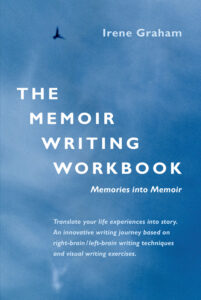
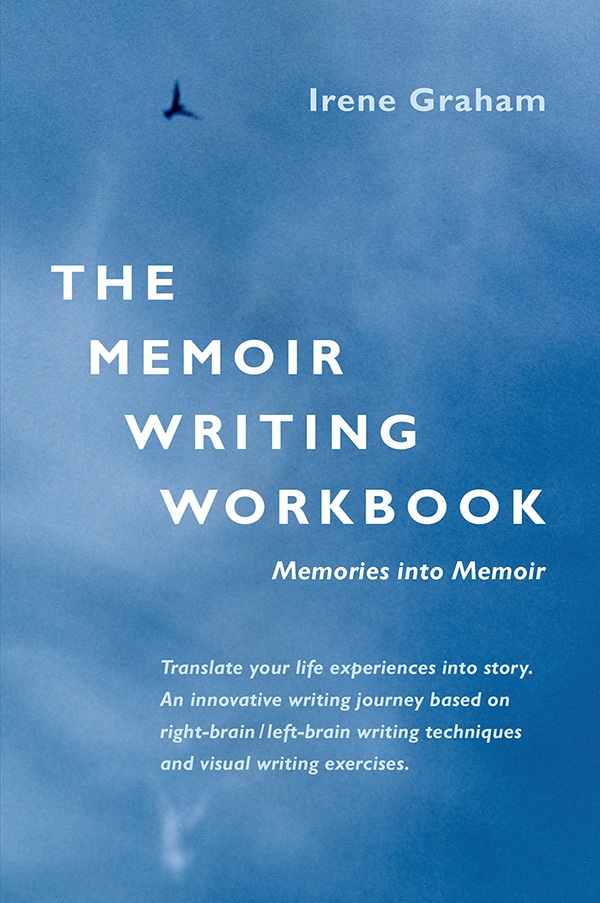
The Memoir Writing Workbook (240 pages) is based on right-brain/left-brain visual writing techniques. It has 36 multi-part focused exercises and 45 writing tips to help trigger memory and learn story creation. Each chapter with examples, show how to develop and write memoir, using the unique Memoir Map.
Do join Irene for a FREE LIVE Chat on How to Start a Memoir Writing Club
Or join Irene in her 12-week Online Memoir Writing Course or on one of her Writing Retreats
Join Irene's Blog
Get occasional writing tips, updates and news from Irene Graham and The Memoir Writing Club, straight to your inbox.