

What is the difference between writing memoir vs autobiography? Are you confused?
A memoir explores a specific theme or period of life, told as story. An autobiography is about a whole life, usually written chronologically, but not written as story.
Learn the key distinctions in content, voice and focus. Find out which form is right for your story. You will also learn how memoir compares to personal essay, biography and more.
Choosing the right form matters.
What is Memoir Writing?
Memoir writing is about drawing upon life experiences and focusing them into a memoir – usually upon a particular subject and the impact it had on the writer’s life e.g.:
- Christmas family parties throughout your life (these could be short memoirs)
- a war veteran and how he or she survived during and after a war
- a story of adoption and the search for birth parents
- the struggle through a particular illness and how it altered and changed a life
- all the cars you owned in your life and where they brought you to (short memoirs)
- growing up with hippie parents, living life on the road
- living in a small community in a minority race and the effect this had on adult life
- the impact of the death of a child on family life
- a sailor’s account of his or her single-handed voyage around the world
One of the differences between memoir writing and autobiographical writing is that you may have several memoirs to write, whereas, the average person, usually has one autobiography.
Well-known figures and people of note, may have one, two or three autobiographies.
Another big difference between memoir writing and autobiography is that when writing memoir, your life experiences are told as story.
Memoir writing is not a million miles from fiction writing, except in memoir writing you translate life experiences into story, and are telling the truth.
My right-brain/left-brain visual writing exercises in The Memoir Writing Workbook help the writer explore personal life experiences, which in turn help to highlight significant life events to develop and shape into story.
Memoir vs Autobiography
In short: a memoir focuses on a particular theme or period from your life, written as story. An autobiography covers your whole life, usually in chronological order, not written as story.
There are other differences too. When writing a personal life story – the language in writing memoir is different to that of autobiography, (or personal essay, journalling etc.). You must choose, when you start your initial writing journey, what form you want to write your story in.
The differences between genre matter. Take fiction writing, for example, before one starts their novel, they name the (sub) genre they will use to write their story. As a romance. Or thriller. Or a children’s story. Or science fiction, etc.
A story can be told in many ways, and if you know the form you want to write in, this in turn will affect your writing voice. For instance, the ‘language’ one would use to write a romantic story will not be the ‘language’ used for writing a thriller.
It is the same for writing personal life story, you need to name the form you want to use to write your personal life story, and develop your writing voice accordingly.
Throughout The Memoir Writing Workbook there are multiple exercises to help you develop and strengthen your writing voice.
Autobiographical writing encompasses a whole life – a life story usually written chronologically from birth to a given point in time. Thus autobiographical writing includes perhaps hundreds of characters, places and events from the writer’s entire life. It is not written as story, like memoir is.
The emphasis is usually on the external facts of a life:
- where and when someone was born
- their family and upbringing
- education and career
- major life events and achievements
- the sequence of what happened over time
Autobiographical writing is less personal than memoir writing. While we may come to know the writer in broad terms, we are less likely to know and understand their personal feelings and attitudes about their life experiences.
And do read my Blog on What is Autofiction? How to Turn Fact into Fiction.
Autofiction is a very powerful form of writing. Do learn and understand what it is.

Table: Difference between Memoir vs Autobiography
Study the table below to help you define the difference between Memoir vs Autobiography.
| Content | Memoir | Autobiography |
| Subject Matter | A significant life experience based on a particular subject matter. Full length or short memoirs. | An entire life. |
| Written as Story | Yes | No |
| Characters & Settings | Focused on characters and setting that are relevant to the subject and story. | Hundreds of characters, places and events from the writer’s entire life. |
| Structure | Can be chronological, but mostly not. | Chronological order |
| Voice | Includes the Retrospective Voice. | Retrospective Voice not used. |
There is no point in writing your book, and then realising half-way through that you are writing autobiography (or another form), when you really wanted to write memoir.
Memoir vs Personal Essay or Mini Memoir vs Short Personal Essay
When it comes to memoir vs personal essay, there is a lot of divided opinion on the matter, but I am a purist when it comes to memoir writing.
Do Note: The content of a full length Memoir or a Personal Essay employs the same differences to that of writing a Mini Memoir or a Short Personal Essay.
Personal essay is not as deep as memoir. Memoir is more about past events that challenged the writer, and the effect it brought to the writer’s life. In memoir we learn more of the writer’s challenges and personal growth.
Personal essay often explores thoughts, insights or commentary on a particular subject, whereas memoir interprets, analyses, and seeks deeper meaning of the writer’s life and what lies beneath the surface of the event they are writing about. It looks at the past to shed light on the present.
Memoir therefore explores the life of the writer, whereas personal essay is free from any need to interpret.
Personal essay can be, but is not usually, written as story. Whereas memoir is always written as story, providing a full narrative arc, with a beginning, middle and end to the story.
The overall result being that the writing voice of the personal essayist is not as reflective as that of the memoirist, who can use their retrospective voice to build layers in their story while weaving the many elements of writing memoir together as a whole.
Memoir vs Journalling
Journalling is significant and certainly has a place in our writing world, but, and I know this from journalling for decades throughout my early years, it can create bad writing habits.
Journalling is great for getting something off your chest. To help you remember a particular time, incident or a travel experience. It can help to loosen the thought processes. It can help encourage you to pick up the pen.
But, journalling allows one to rant on and on about something. It is not about concise writing, as memoir writing demands. And it is not based on story creation, also as memoir demands.
In my 35 years of facilitating writing retreats and my 12-week Online Memoir Writing Course I’ve noticed participants who are intrepid journal writers have to work harder at finding their writing voice, because for years they just wrote and wrote and wrote.
They have to learn to pull back on words, to keep focused and write in a concise manner.
And when one understands story creation, that becomes the basis and focus for writing personal life story, instead of writing just words on the page without direction.
Memoir vs Biography
Biographical writing is telling the story of another person’s life. It is not writing about your life. You are not the central character, they are. You are not in the story, and if you are, it’s from their perspective, not yours.
A biographer documents the life of another, usually through research, such as interviews, letters and records as they compile the life story of that person.
Memoirists often feel they want to write a story about their incredible granny or brilliant father, which is possible, but it must be from your perspective and how this person was in your life, and how they influenced you.
Remember, it is your personal life story you are writing, your memoir. The story is about you, and you have chosen to bring other characters like granny, into your story.
Memoir vs Ghostwriting
Ghostwriting memoirs has grown in popularity in the last decade. A ghostwriter is a professional writer, hired to create and write a memoir of someone’s life.
The reason it is different to that of a biography, is because the memoir is written by the ghostwriter, in the first person – as if the memoir was written by the person who is the subject of the memoir.
As part of the contract to ghostwrite another person’s life story, the ghostwriter allows the client to take full authorship and credit for the work. The name of the ghostwriter is never mentioned. It is also, in some rare cases, agreed that authorship is co-authored.
Ghostwriters write memoirs, biographies, business non-fiction, blog posts, speeches and at times, fiction.
Family History into Memoir
Writing family history is very different to memoir writing. It is about the lives of ancestors, not your life per se, although you could of course be included in that narrative.
Writing family history transforms genealogical research into an engaging narrative that preserves heritage and brings the past to life.
I have helped a number of workshop participants blend family history with memoir by
weaving the stories of ancestors into their own life stories, through:
- Comparing their life to that of yours – via time / social history / age / financial status / traditions / values etc.
- Developing who your ancestors were, as characters in your memoir
- Including your perspective from interviews on who they were, and the stories of their lives.
The above is a very brief example of how it is possible to include family history into your memoir. It does require a clear focus on what you want to achieve, and how to handle it. An excellent example of this process is the book, The Hare With Amber Eyes by Edmund De Waal.
How to Choose the Right Form for Your Story
You have already begun! The above information will help you see the wood for the trees and help you understand the foundation of writing memoir, compared to autobiography and other forms of writing.
You need to ascertain at a very early stage in your writing, not only what it is you want to write, but what form you are going to use to write your personal life story. You need to name the genre you are interested in.
Otherwise your writing will never find form. And never find a reader interested in your work, because it will most likely be mixed up and not focused.
The answer as to what form you will choose to write your personal story will unfold naturally as you start the initial writing process in The Memoir Writing Workbook. Trust the process.
And because you now know the difference between writing memoir vs autobiography, and other forms of writing, you will also be able to make that decision – at the start of your writing journey.
Happy Writing!
Irene Graham
Want a helping hand and guide to put this into practise?
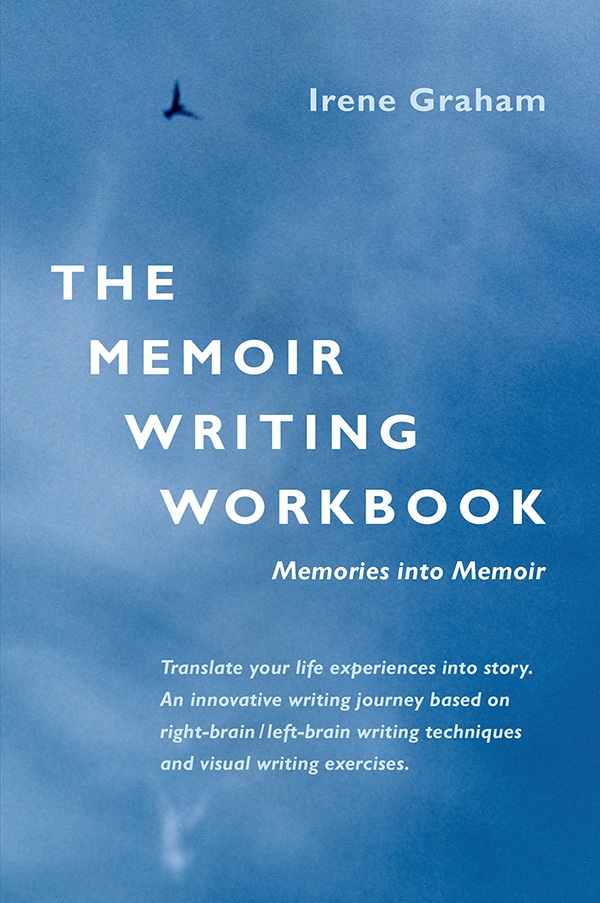
The Memoir Writing Workbook (240 pages) is based on right-brain/left-brain visual writing techniques. It has 36 multi-part focused exercises and 45 writing tips to help trigger memory and learn story creation. Each chapter with examples, show how to develop and write memoir, using the unique Memoir Map.
Do join Irene for a FREE LIVE Chat on How to Start a Memoir Writing Club
Or join Irene in her 12-week Online Memoir Writing Course or on one of her Writing Retreats
Join Irene's Blog
Get occasional writing tips, updates and news from Irene Graham and The Memoir Writing Club, straight to your inbox.