

Are you seeking answers as to how to write a memoir about your life? And don’t know where to start?
Perhaps you have a vague idea that keeps nudging you to pick up the pen? This beginner’s guide will help.
I will take you on an exciting writing journey, as you learn the A to Z of how to write your memoir. A good one.
Memoir Writing – Made Easy with Irene Graham
The reason my approach to memoir writing is different, is that it utilises right-brain/left-brain visual writing techniques.
This approach is innovative and unique. No other memoir writing course or book on how to write memoir will show you how to write a memoir using these techniques.
And after 35 years of teaching, and all the feedback I’ve received, I know these techniques work. They are proven. They remove the complexity of what can be an enormous task to define what it is you want to write about, and how to go about it.
I’ll show you how to simplify each step of writing your memoir.
You can also learn more about my writing techniques in my Blog: Right-Brain vs Left-Brain – What’s the Difference?
Think like Ernest Hemingway. Remember his quote: “We are all apprentices in a craft where no one ever becomes a master”.
Think like Ernest Hemingway. Remember his quote: “We are all apprentices in a craft where no one ever becomes a master”.
Can Anyone Write a Book?
Back in the day, and not so long ago, it was perceived that one had to be a scholar of greatness to write a book. Thankfully that has changed, and I am sure the popularity of memoir has helped change that concept too.
Everyone has a story to tell. That’s a fact.
Our lives are filled with extraordinary events and happenings, and by being able to express those experiences through story, and writing your story in a creative structure, is the key to writing a book.
Do remember, if you feel you are not able to write a full-length book, you can write short memoirs. In fact, I encourage first time writers to initially concentrate on writing a short memoir before tackling a full length memoir.
It’s like learning how to write a short story before writing a novel. In the design and structure of The Memoir Writing Workbook, readers have an option to create a short memoir, or a full length memoir, as they proceed through the workbook.
If you feel you are not able to write a full-length book, you can write short memoirs.
Writing a book requires focus. It’s a step-by-step journey that taken with direction will show you how to complete your story and your book.
And if you feel you would prefer to write in a group, which is a wonderful thing to do, read my Blog: How Can I get Feedback on my Memoir?
How to Start Your Memoir When You Don’t Know Where to Begin
So, before you begin your writing journey it is good to ask yourself the following questions, to help define your writing goals.
Do I want to:
- write my memoir for family and friends?
- write my memoir for publication?
- develop my life experiences to write as Autofiction?
- use memoir writing as a therapeutic process?
This is a good starting point, to help give you direction, as to what you want to achieve in your writing, and how to approach your manuscript.
Each choice is a worthwhile writing goal. To help you define further your writing goals the following explanations will help.
Writing your Memoir for Family and Friends
You have a desire to leave a little, at least, of your life in print, as a legacy for future generations. This is such a worthwhile goal. And a valuable one.
You may not feel you are ‘a writer’ or have had a very dramatic or interesting life, but that’s not to say you don’t have things to write about – of course you do. You have millions of things to write about.
You may not have the enthusiasm or energy to write a full length memoir, but you can certainly achieve your writing goals by writing short memoirs relating incidents and experiences of your life – that your family and future generations will thank you for.
It is important to write your stories as well as you possibly can, so that they will be of interest to the reader, wanting to turn each page to know more of your life, as opposed to just scribbles and a half-hearted approach to your writing.
So it is really worthwhile to plan your writing journey to help you achieve this goal.
A good starting point is to use the Memoir Map in The Memoir Writing Workbook as your guide, and follow the step-by-step approach on how to trigger memory, develop, structure and write your short or full length memoir.
Writing your Memoir for Publication
You have a story and you want to share your life experience/s with a broader audience through publication.
There are many routes to publishing these days; the ‘Big Five’ traditional publishing houses – Penguin Random House, HarperCollins, Simon & Schuster, Hachette, and Macmillan.
Or Self-Publishing, or even Hybrid Publishing, which is a mixture of both traditional publishing and self-publishing.
Publishers demand as much perfection as possible. Therefore if your writing goal is to get published, you will want to create your story and memoir to the highest standard possible.
To this end your dedication to the project will possibly run deeper than the goal of not wanting to be published and to write a good story for family and friends. And you may possibly choose to self-publish – to a high standard.
What has Autofiction got to do with Memoir Writing?
Autofiction, previously called Autobiographical Fiction, is growing in popularity. It is a very powerful form of writing. The autofiction genre allows the writer to weave life experience with imagination, therefore bending the truth, so to create a work of part-fiction and part-truth.
Autofiction allows the writer to write about incidents in their life that they feel they cannot write about in memoir (by telling the factual truth) such as deep trauma, secrets and untold personal feelings.
Autofiction allows the writer to write about incidents in their life that they feel they cannot write about in memoir (by telling the factual truth) such as deep trauma, secrets and untold personal feelings.
This can be achieved, for instance, by incorporating a personal life incident into the life of a fictional character, and embellishing it further to create an engaging story. The result is the reader does not know which part of the story is true, and which is fictional.
Learning how to write memoir provides a solid foundation in understanding how to create story and develop life experiences, that you can later use to translate into autofiction.
Participants in my online memoir writing courses and memoir writing retreats agree with me that by studying memoir writing helps the writer write better fiction. Strange but true.
I believe this is because by learning to develop story through writing memoir, using personal life experiences – provides a connection between experience and the understanding of story creation, which ultimately shows the writer how to engage with, and form story, on a deep level.
It’s powerful.
To find out more about writing Autofiction, do read my BLOG: What is Autofiction? How do I Turn Fact into Fiction?
My book, The Memoir Writing Workbook, my 12-week Online Memoir Writing Course and my Writing Retreats are based on showing the writer how to create each element of story using personal life experiences and innovative right-brain/left-brain writing techniques.

What is Therapeutic Writing? Is it for me?
The big difference in choosing to use memoir writing as a therapeutic process is that the writer ‘removes the edit button’ so to speak, and feels free to write absolutely anything on the page. Their thoughts, their feelings, their rants, their woes.
They can use language that would not be suitable for publication. They can blame people for wrongdoings. They can write about the deepest of thoughts and feelings, without thinking of story or creative input.
The purpose of using memoir writing as a therapeutic process is to ‘get it off your chest’. And writing is a perfect outlet to make that happen.
The outcome of using memoir writing as a therapeutic process is that the writer can encounter and often remembers other ‘good things’ that happened in their life, which prior to writing it all out, was often buried in their pain. And within this process pain can be alleviated.
The outcome of using memoir writing as a therapeutic process is that the writer can encounter and often remembers other ‘good things’ that happened in their life.
It is recommended to work with a therapist when engaging with memoir writing as a therapeutic process.
Write Your Memoir – 6 First Steps by Irene Graham
Think about what you have already learned from the above advice, has it helped you to define a little bit of your memoir writing journey?
Follow the steps below as a Beginner’s Guide on how to write a memoir about your life, to help uncover which direction is the one you seek. First, you need a plan.
- Commit to learning the craft. Writing is like any art form or skill, it takes time. If you wanted to be a visual artist, hairdresser or a carpenter you would plan your approach as to how you would achieve this goal. Writing is exactly the same, you need to plan your course of action, buy books, do a course, develop your skills each step of the way. And enjoy it!
- Understand what memoir writing is. Read my Blog: Memoir vs Autobiography, What’s the Difference?
- Learn how to tap into your creativity, read my Blog: How Can I Tap into My Creativity?
- Decide your end goal and audience – who is your memoir for?
a) Do you want to write for family and friends and / or go the publishing route?
b) What type of publishing are you interested in? Self-Publishing / Traditional / Hybrid?
c) Are you interested in developing memoir for Autofiction purposes?
d) Is Therapeutic Writing your goal? - Give yourself a writing goal. Name it. Write out what it is you will do to achieve this goal, and what action you will take. And put a time scale on it. Make it realistic. Plan for six months or a year at a time. Make sure it is achievable within your busy life schedule.
- For extra help, do read my Blog: Can Anyone Write a Memoir?
6 Writing Tips for Beginners – Irene Graham
- Designate a time of the day, or week, or a number of times during the week that is your writing time. eg: If you plan on writing at 7am each morning, and you find that you consistently miss this deadline, then it’s not the right plan for you.
Make another plan, or another, and find the time that works for you in your busy life schedule. This is so important, otherwise you will always have an excuse, and writing will ultimately be put on the back boiler… and not happen. - I also advise that it is good to dedicate a two hour period for your writing. Less than two hours doesn’t allow for deep creativity. And from my workshop experiences, it seems that after writing for more than two hours the brain needs a break! But if you only have one hour, go for it. You can build upon this at any stage.
- Prepare a happy writing space that is yours. It could be a cosy corner in a room, under the stairs, a room in your house, or even a shed in the back garden… just make sure it’s yours, and everyone else is off limits. Tell family to stay away!
- Organise what you need to write your memoir – is it on computer? By hand? Many people enjoy writing by hand, and that is perfectly ok. The Memoir Writing Workbook provides a list of things you need to help prepare.
As the exercises in the workbook are completed using right-brain/left-brain visual writing techniques, you will use a variety of tools and items to interact with to help power up your senses, which in turn will help you dig into your well of memory and help you write. (It’s a lot of fun!) - And of course use a pen/s that you like writing with. Include highlight pens in your writing arsenal.
Most writers use a combination of the above, and then use their computer to complete the exercises.
Happy Writing!
Irene Graham
Want a helping hand and guide to put this into practise?
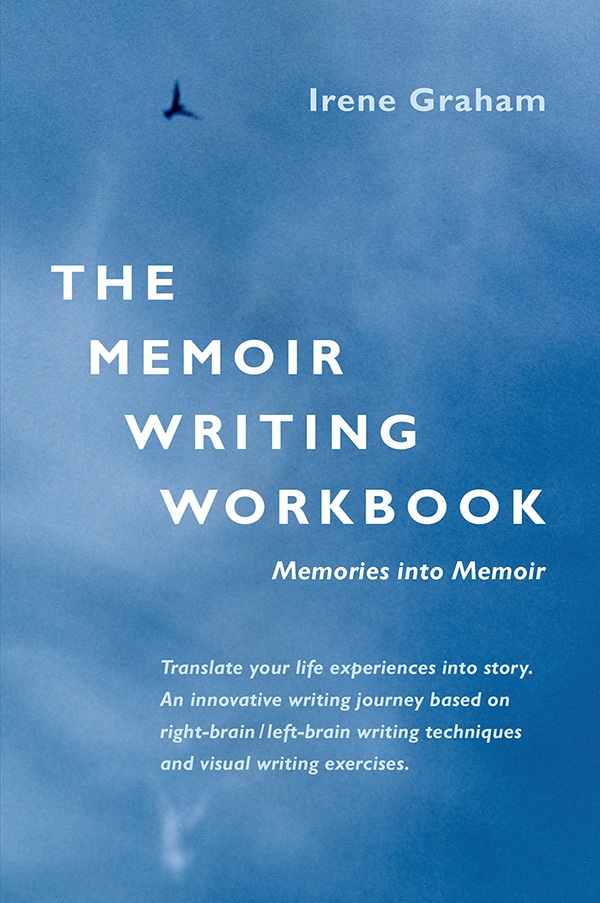
The Memoir Writing Workbook (240 pages) is based on right-brain/left-brain visual writing techniques. It has 36 multi-part focused exercises and 45 writing tips to help trigger memory and learn story creation. Each chapter with examples, show how to develop and write memoir, using the unique Memoir Map.
Do join Irene for a FREE LIVE Chat on How to Start a Memoir Writing Club
Or join Irene in her 12-week Online Memoir Writing Course or on one of her Writing Retreats
Join Irene's Blog
Get occasional writing tips, updates and news from Irene Graham and The Memoir Writing Club, straight to your inbox.