

Right-Brain vs Left-Brain. Do you know the difference?
Participants come to my memoir and fiction writing workshops saying, ‘Oh, I am very right-brained,’ meaning they are very creative, while others say apologetically, “I only seem to function with my left brain,’ meaning they feel they haven’t an ounce of creativity in their soul.
Neither of these views is correct.
We function, whether we are aware of it or not, with both sides of our brains. The right-brain and the left-brain.
Understanding Right-Brain vs Left-Brain Thinking
The understanding of how our brains work is relatively new. Little was known about right-brain thinking abilities until World War II, when neuroscientists studied patients with brain damage.
In 1981, Roger Sperry, at the California Institute of Technology, was awarded a Nobel Prize for his discoveries concerning the functional specialisation of the cerebral hemispheres.
His work allowed greater insights into the specialisation of the two hemispheres of the brain.
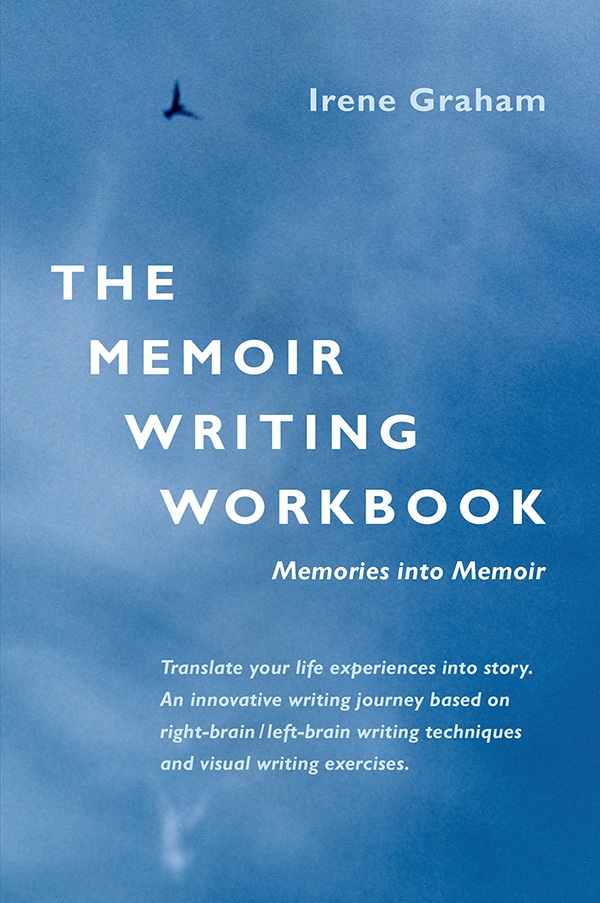
While my workbook, The Memoir Writing Workbook is based on right-brain / left-brain writing techniques and exercises to help write memoir, it is not about neuroscience or how the brain works.
But it is important to understand a little about how we think, so that you are aware of the workings of your own brain, and how you as an individual can develop it.
Right-Brain vs Left-Brain – Which am I?
It is important to realise that it is not an advantage to be either right-brained, or left-brained. We have two hemispheres in our brain – the right-hemisphere and the left-hemisphere.
And we need to utilise both hemispheres for optimum productivity and performance, consciously working with our strengths and developing our weaknesses.
We function, with both sides of our brains. We may be more developed in one side than the other, but that is our challenge.
We need to develop our skills so that we can work with both sides of our brains and ultimately be able to flip from one side to the other, and perform to our optimum.
Do read my Blog: How Can I Tap into My Creativity to do a Creative Brain Exercise.

What is Right-Brain / Left-Brain Writing?
Writing certainly requires the discipline of being able to flip from one side of the brain to the other. The left side of the brain asks the questions:
- What do my characters look like?
- How will I structure my story?
- What is going to happen next in my story?
- How will I resolve the plot?
It is the right side of the brain that informs these questions creatively.
Take music as an example. Most of us just hear the melody of a song – with our right brains – but the composer uses his or her left brain to arrange the notes, make the music work and integrate the music with the words.
The composer is therefore using both sides of his or her brain, and this is similar to the way writers work.
Right! LEft! Left! right! Right! Left!
What we do with our left hand, left leg and left foot is receiving signals from the right side of the brain, and vice versa.
Right-Brain vs Left-Brain Thinking – How it Works
Research on the brain has revolutionised our concept of how we think. We now know that the two sides of the brain serve radically different functions.
Study the table below to understand how each side of your brain works.
| left brain | right brain |
| Associated with: -Analytical -Linear -Sequential thought Good at: -Mathematics -Logical Thinking | Associated with: -Spatial -Integrative -Simultaneous thought Good at: -Mental Imagery -Lateral & Spatial Thinking |
| Governs: -Objective -Precise language Good at: -Reports & Information -Accurate with language -Constructs words that have a precise meaning | Governs: -Evocative language -Associative language Good at: -dreamy, evocative language -mental connections between ideas -implies additional meanings and suggestions, beyond literal meaning -involves emotions & sensory details |
Modes of Thinking
Howard Gardner, the renowned psychologist, and author of Frames of Mind, The Theory of Multiples Intelligences, explains modes of thinking as outlined in the table below.
| Mode of Thinking | Governs |
| Linguistic | -Listening -Speaking -Writing -Foreign Languages |
| Musical | -Appreciation -Rhythm & Pitch -Singing -Playing Instruments -Composing |
| Visual-Spatial | Thinking in: -Images -Pictures -Diagram -Form |
| Bodily-Kinaesthetic | Ability to: -Control Bodily Movements -To handle objects skilfully |
| Mathematical / Logical | -Skills re numbers -Reasoning -Abstract Thinking -Problem Solving |
| Interpersonal | -Ability to empathise with moods and feelings of others |
| Intrapersonal | Capacity for: -Self-awareness -Intuition -Flexibility of thoughts and beliefs |

Examples of Right-Brain / Left-Brain Thinking Differences
The following are simple examples of how our right brain thinks differently to that of our left brain, as outlined below:
- A cat runs across the room…
-Left Brain mentally spells the word: C A T
-Right Brain sees image of cat – mentally draws a picture of the cat. - You pick a daisy from your garden…
-Left brain mentally pulls the petals from the centre disc. Could line them up in a line, and even count them.
-Right Brain sees the whole design of the daisy, studies the patterns, how the petals join the disc in the centre. Studies the colours, and how they interact with one another.
So therefore, the left side of the brain is more like a computer. It is analytical. It does things in stages. It is logical.
Whereas, the right-side of the brain is more like a kaleidoscope. It sees the full pattern. The colours. And mixes it all together to create the whole.
Right-Brain / Left-Brain – Writing Memoir
My right-brain / left-brain visual writing exercises in The Memoir Writing Workbook help the writer explore personal life experiences, which in turn help to highlight significant life events to develop and shape into story.
The 240 page Memoir Writing Workbook is filled with exercises, tips and writing tricks. The writer follows the innovative Memoir Map along a writing journey, learns story creation and how to write an engaging memoir – all using right-brain / left-brain concepts.
It is a unique approach to writing memoir. And it works!
I also encourage writers to Start a Memoir Writing Club or group in their area using The Memoir Writing Workbook as your guide. Writing Clubs help provide feedback and support as you write. It’s a great way to learn and to keep motivated as you write.
Read more about this concept in my blog post: How Can I Get Feedback on My Memoir?
Right-Brain / Left-Brain Writing Tip
Remember this tip each time you start to write.
Spelling: Forget about spelling correctly as you write. Spelling is of course important, as are grammar and punctuation, but what is more important as you write your memoir is your freedom to write creatively.
Spelling, grammar and punctuation are functions of editing and are controlled primarily by the left brain. When you are in a flow of writing and you stop to correct a spelling, you automatically inhibit your creative flow.
It is more constructive to forget about editing your work as you write, to stay in your right brain and continue to write creatively.
At a later stage you can reread your work and edit it at the same time. Then you can use your left brain, which will enable you to focus purely on editing your work.
Go Write!
Want a helping hand and guide to put this into practise?
The Memoir Writing Workbook (240 pages) is based on right-brain/left-brain visual writing techniques. It has 36 multi-part focused exercises and 45 writing tips to help trigger memory and learn story creation. Each chapter with examples, show how to develop and write memoir, using the unique Memoir Map.
Do join Irene for a FREE LIVE Chat on How to Start a Memoir Writing Club
Or join Irene in her 12-week Online Memoir Writing Course or on one of her Writing Retreats
Join Irene's Blog
Get occasional writing tips, updates and news from Irene Graham and The Memoir Writing Club, straight to your inbox.